
die casting
PreciseOne Die Casting
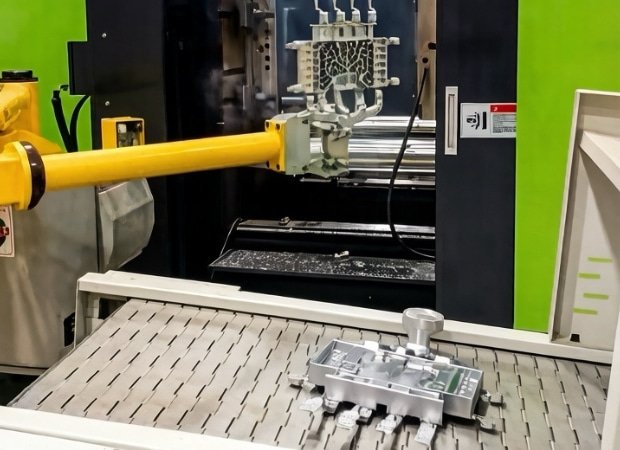
Die casting is generally the most cost-effective method for producing complex-shaped components from aluminum alloys, and rheocasting also offers potential for low-cost production. Die casting provides an economical way to manufacture large quantities of intricately shaped, high-precision light metal products.
In this process, molten metal is injected at high speed into a water-cooled metal die or mold. Upon contact with the cooled surface, the molten metal solidifies rapidly. Once solidification is complete, the mold opens and ejector pins are mechanically activated to release the parts. The die is then exposed to air, sprayed with lubricant, closed, and ready for the next injection cycle.
Advantages of Die Casting
Die Casting Capabilities
Rapid Tooling
Ideal for low-volume production, this method uses aluminum inserts with a lifespan of up to 20,000 cycles. Typical lead time is 1–2 weeks, helping to significantly reduce overall production timelines.
Low-Pressure Die Casting
In this process, molten metal is forced into the mold using air pressure, making it suitable for mass production. Machining typically takes 3–4 weeks, and the tooling can last up to 100,000 cycles.
High-Pressure Die Casting
This method employs a hydraulic ram to inject molten metal into the die at extremely high pressures. It not only enhances manufacturing efficiency but also helps minimize unit costs.
Gravity Permanent Mold Casting
This process uses a metal mold combined with a gravity-fed metal delivery system. The approach reduces overall process costs while leveraging the higher cooling rate of the metal mold. Its advantages and limitations are generally similar to those of low-pressure permanent mold systems.
Contact us
Need Roofing Services?
Call To Ask Any Question
123-456-7890